Five Things to Know Before Selling Your Home in the San Gabriel Valley
Seller's Guide The Mark & Al Team September 29, 2026
Seller's Guide The Mark & Al Team September 29, 2026
Selling a home in the San Gabriel Valley is a micro-market exercise. Glendora, San Dimas, La Verne, Covina, West Covina, Azusa, Pasadena, Monrovia, Walnut, and surrounding communities should not be treated as one interchangeable market.
Even current city-level data shows substantial differences. Over the three months ending August 2026, Redfin reported all-home-type median sale prices of approximately $939,000 in Glendora, $1.23 million in Pasadena, and $858,000 in West Covina. Those numbers are market snapshots rather than estimates of any individual home's value, but they demonstrate why local comparable sales matter. [1]
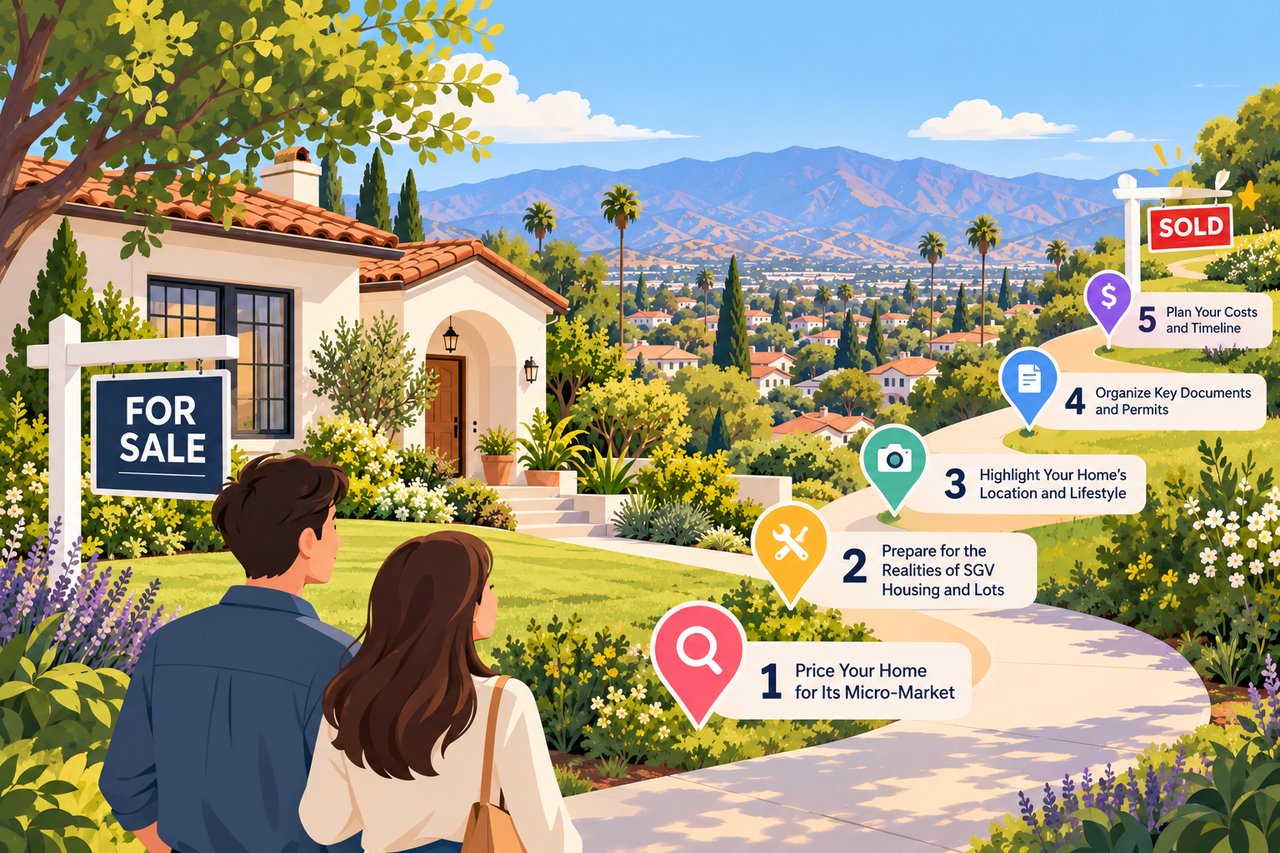
For sellers, the practical priorities are to price against the most relevant nearby competition, address maintenance issues strategically, market the property's lot and location as carefully as the interior, organize permits and improvement records before escrow, and build a realistic budget and timeline before going live.
One of the biggest mistakes a San Gabriel Valley homeowner can make is starting with a broad Southern California statistic and assuming it applies directly to the property.
A stronger approach begins with the smallest useful comparable-sales area and expands only when necessary. Citrus Valley REALTORS®, which has an office in Glendora, provides interactive market reports designed to track active listings by month, price range, and region. That kind of segmentation is more useful to a seller than a single Los Angeles County average. [2]
For an actual pricing analysis, compare properties that are genuinely similar in location, property type, size, lot characteristics, condition, parking, improvements, and additional living space. A renovated foothill home on a usable lot may require a different comp set from an original-condition house a few blocks away. Condos and townhomes should generally be evaluated against similar attached housing rather than against detached houses simply because they share a ZIP code.
The current market illustrates why that distinction matters:
Example SGV submarket | Housing and location context | Buyer priorities worth emphasizing | Pricing considerations |
Glendora | Detached homes, foothill properties, condos and townhomes; Downtown Glendora Village and new A Line access | Yard, garage/parking, condition, foothill setting, transportation and local amenities | Separate neighborhood and property-type evidence; lot utility and condition can materially change the appropriate comp set |
Pasadena | Character and historic housing alongside conventional detached homes, condos and townhomes; walkable commercial/cultural districts | Architecture, condition, parking, walkability, dining/culture and transit | Neighborhood and property type are especially important; do not use a citywide median as a pricing formula |
West Covina | Suburban detached housing plus attached options across multiple neighborhoods | Usable outdoor space, garage/parking, system updates, shopping and commuter access | Compare within the closest relevant neighborhood, lot range and condition category rather than across the entire city |
Pasadena's official visitor organization, for example, specifically highlights historic architecture, walkability, shopping, dining, museums, gardens, and distinct neighborhoods, while Glendora city materials identify Downtown Glendora Village and a broad network of parks and recreational areas. Those differences are part of why two SGV homes with similar square footage can occupy very different competitive positions. [3]
Many San Gabriel Valley sellers are working with homes in established neighborhoods rather than brand-new construction. In that context, preparation should go beyond staging.
Before spending heavily on cosmetic remodeling, examine the property's major systems and obvious deferred maintenance. Roof condition, electrical and plumbing work, HVAC, windows, drainage, foundation-related issues, water intrusion, landscaping, and visible repairs can all become part of a buyer's due-diligence process.
The practical goal is not to make an older house look new. It is to eliminate preventable distractions and understand what you are selling before a buyer investigates it.
Lot features also deserve special attention. A usable backyard, detached garage, long driveway, existing accessory dwelling unit (ADU), outdoor entertaining area, or unusually flexible parking arrangement may deserve prominent photography and description rather than a passing mention near the end of the listing.
Be more cautious with phrases such as “ADU potential.” California continues to update its ADU framework. The California Department of Housing and Community Development updated its ADU Handbook in March 2026 and maintains guidance concerning state law and local ADU ordinances. Local planning and building requirements still matter for a specific property. [4]
Accordingly, market an existing permitted ADU differently from a backyard that might accommodate one. If permit status or development potential is uncertain, verify it rather than presenting possibility as fact. In Glendora, for example, Community Development handles zoning review and building permits, illustrating why municipal records should be part of the research process. [5]
A localized SGV marketing plan should explain why the specific address is useful, not simply announce that the property is “conveniently located.”
Transportation is a good example. LA Metro officially opened the nine-mile A Line extension from Azusa to Pomona in September 2025, adding service to Glendora, San Dimas, La Verne, and Pomona. Metro says the extension improves connections toward destinations including Pasadena, Downtown Los Angeles, and Long Beach. [6]
For a property genuinely convenient to a station, that is meaningful information. For another home, access to the I-210, I-10, or I-605 may be more relevant. Sellers should describe actual access rather than promise commute times, which can vary substantially with traffic. Caltrans maintains QuickMap for current highway conditions and closures. [7]
Neighborhood marketing should be equally specific. A Pasadena property might benefit from proximity to a walkable commercial district, architecture, museums, dining, or shopping. Glendora marketing might emphasize Downtown Glendora Village, foothill recreation, parks, or A Line access when relevant. [8]
The same principle applies in Monrovia, Covina, Azusa, Walnut, West Covina, and other SGV communities: identify the nearest real amenities and transportation options instead of filling the description with generic Southern California lifestyle language.
That also leads to a better way to think about buyers. Avoid demographic assumptions. Instead, market functional benefits: transit access for someone who values rail, a permitted ADU for someone who values flexible living space, a garage for someone who needs storage or parking, architectural character for someone seeking an older home, or a usable backyard for someone who values outdoor space.
A seller should begin building a property file before the home goes on the market, not after the buyer starts asking questions.
Gather available records for significant work such as roof replacement, HVAC, electrical upgrades, plumbing, windows, solar, foundation work, kitchen or bathroom renovations, additions, garage conversions, and ADUs. Include approximate completion dates and, when available, invoices, warranties, permits, and final approvals.
This is particularly important in California because sellers have disclosure obligations. The California Department of Real Estate maintains a publication specifically addressing disclosures required of sellers and real estate licensees. [9]
Good documentation also improves consistency throughout the transaction. The listing description, seller disclosures, inspection discussions, and information provided for appraisal should not tell four different stories about the property.
For example, instead of simply saying “newer roof,” document when it was replaced. Instead of assuming a converted garage is permitted living area, check municipal records. Instead of expecting an appraiser to discover every upgrade independently, prepare a concise improvement sheet identifying significant completed work.
The objective is not to influence the appraiser or conceal defects. It is to make the home's factual history easier to understand.
A seller's strategy should be based on net proceeds and the terms of the sale, not just the highest possible asking price.
Before listing, prepare a property-specific estimate that accounts for likely preparation expenses, cleaning, repairs, photography or staging, negotiated brokerage compensation, escrow and title-related charges, applicable taxes or fees, possible negotiated buyer credits, loan or lien payoffs, moving or storage expenses, and a reasonable contingency for unexpected items.
California DRE also provides consumer guidance on the state's escrow process, underscoring the importance of understanding what happens between contract and closing. [9]
Timing should be planned backward from the seller's desired move. The sequence is more important than the exact number of weeks. A home requiring permit research, extensive repairs, tenant coordination, estate documentation, or a complicated move may need significantly more lead time.
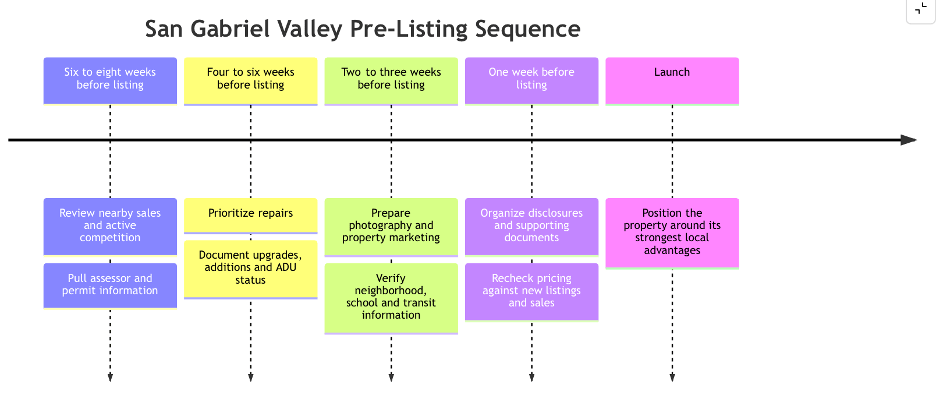
The sequence is more important than the exact number of weeks. A home requiring permit research, extensive repairs, tenant coordination, estate documentation, or a complicated move may need significantly more lead time.
Once offers arrive, evaluate price together with financing, contingencies, appraisal terms, requested credits, and closing or possession timing. The offer with the largest headline number is not automatically the offer that best serves a particular seller.
Selling successfully in the San Gabriel Valley starts with recognizing that there is no single “SGV market.” Current data alone shows meaningful differences among Glendora, Pasadena, and West Covina, while transportation, housing type, lot characteristics, condition, and neighborhood amenities create further differences within each city.
For homeowners in Glendora, San Dimas, La Verne, Covina, West Covina, Azusa, Pasadena, Monrovia, Walnut, and surrounding communities, the strongest strategy is property-specific: use the right comps, make selective repairs, document improvements, market the home's genuine local advantages, and understand costs and timing before the listing launches.
The Mark & Al Team can help you review local comparable sales, evaluate your home's position in the San Gabriel Valley market, and develop a selling strategy based on your property and your goals. Call The Mark & Al Team at 626-335-6000 to discuss your home-selling options.
[1] Redfin — 2026 Glendora Housing Market: House Prices & Trends as of August
https://www.redfin.com/city/7650/CA/Glendora/housing-market
[2] Citrus Valley REALTORS®
https://www.cvar.net/
[3] [8] Visit Pasadena — Things to Do in Pasadena, CA
https://www.visitpasadena.com/
[4] California Department of Housing and Community Development — Accessory Dwelling Units
https://www.hcd.ca.gov/building-standards/adu
[5] City of Glendora — Community Development
https://www.cityofglendora.gov/Explore/Community-Development
[6] LA Metro — A Line Extension Between Azusa and Pomona
https://www.metro.net/about/media-relations/possibility-travels-with-you-metro-a-line-extension-between-azusa-pomona-officially-opens-providing-more-connections-from-san-gabriel-valley-to-destinations-throughout-la-county/
[7] Caltrans QuickMap
https://quickmap.dot.ca.gov/
[9] California Department of Real Estate — Publications
https://dre.ca.gov/publications/CompleteListPublications.html
Stay up to date on the latest real estate trends.
New Listing
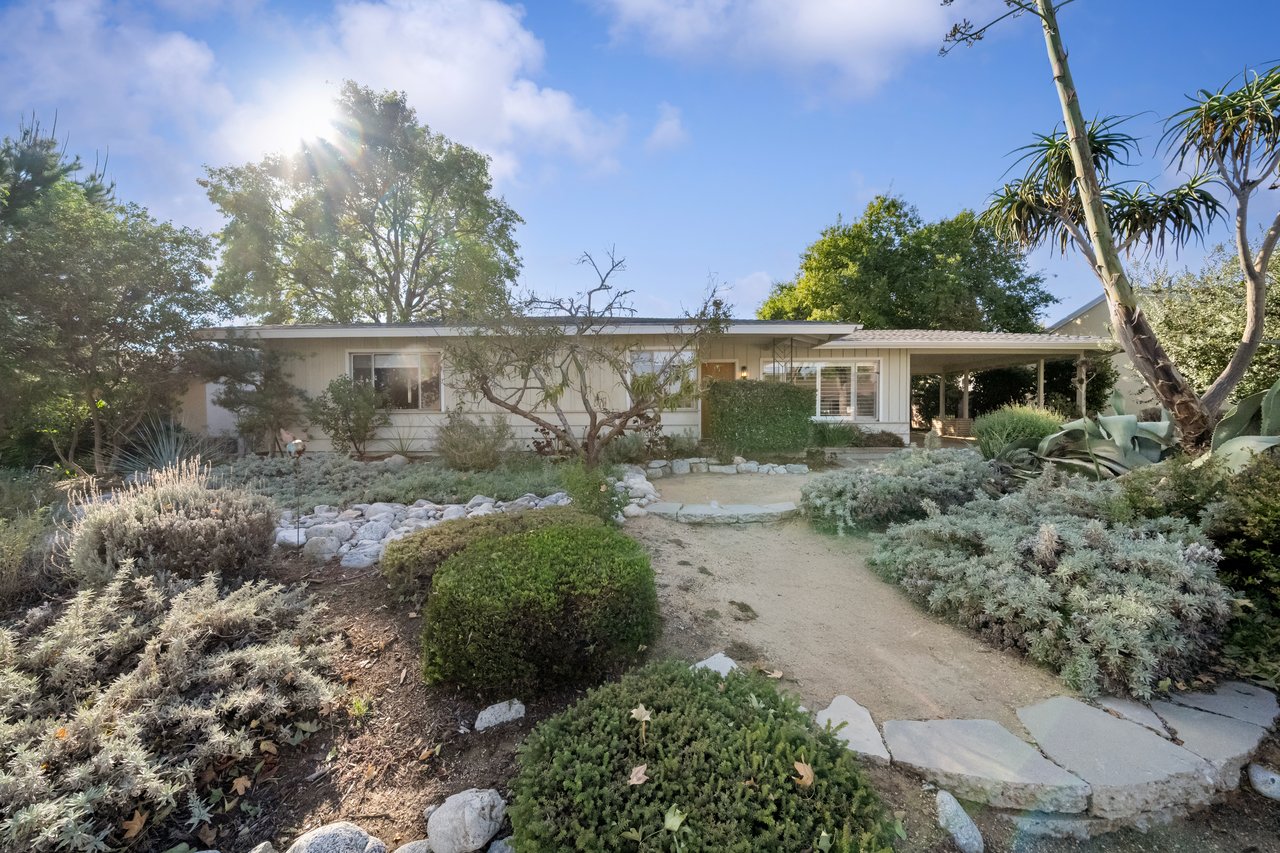
Offered at $824,000 | 4 Bedrooms | 2.5 Bathrooms | 2,249 Sq. Ft.

Seller's Guide

Real Estate Terms Explained

Seller's Guide
Charming Home with A Spacious Backyard in La Puente
New Listing
Custom-Built Home on One Acre in Rancho Cucamonga's Alta Loma Community
Our team is ready to handle every aspect of your transaction to facilitate the home buying, selling, commercial, or retail sale process. From the largest estate property to the first time buyer purchase, commercial real estate, and everything in between, we have the experience and knowledge to help.