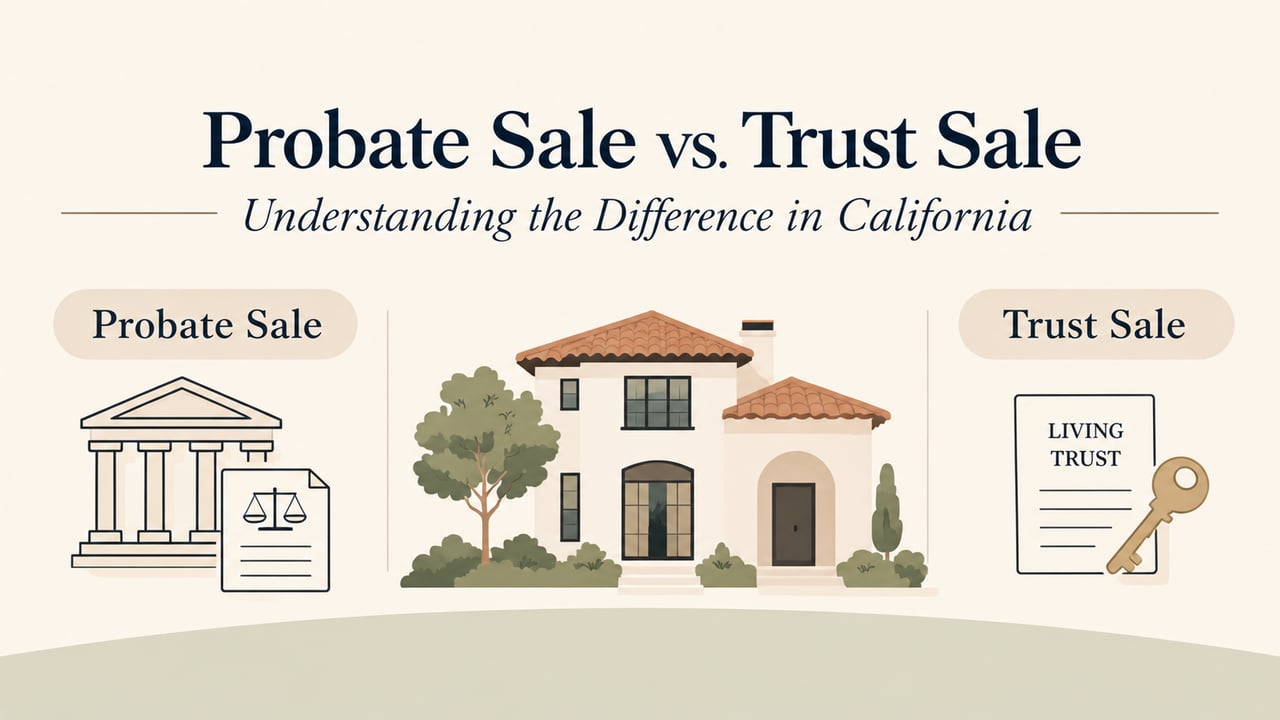
Probate Sale vs. Trust Sale: What’s the Difference in California?
Real Estate Terms Explained Mark and Al Team October 16, 2026
Real Estate Terms Explained Mark and Al Team October 16, 2026
When a homeowner passes away in California, their property may be sold through probate or a trust. Although both involve selling real estate after someone's death, they follow different legal procedures.
The biggest difference is who has authority to sell the property and whether court approval is required. This affects the timeline, costs, flexibility, and risks for buyers and sellers.
Understanding these differences can help California homeowners, beneficiaries, and buyers prepare for a smoother transaction.
Understanding Probate Sales and Trust Sales
What Is a Probate Sale?
A probate sale occurs when property belonging to a deceased person's estate is sold by a court-appointed executor or administrator, known as a personal representative.
Under California Probate Code §10308, estate real estate sales generally require court confirmation unless the representative has sufficient independent authority.
California's Independent Administration of Estates Act (IAEA) allows certain representatives to sell property without a separate court confirmation hearing.
There are two main situations:
Court-confirmed probate sale: The representative accepts an offer and petitions the court to approve the sale. Other buyers may submit higher bids at the confirmation hearing.
Probate sale with full IAEA authority: The representative can generally sell without court confirmation. However, interested beneficiaries or heirs typically receive a Notice of Proposed Action, generally allowing at least 15 days for objections under Probate Code §10586.
Full IAEA authority makes a probate sale more similar to a conventional real estate transaction.
What Is a Trust Sale?
A trust sale occurs when property held in a trust is sold by an authorized trustee.
Many California homeowners establish revocable living trusts so their property can be managed and transferred after death without going through ordinary probate.
Under California Probate Code §16226, trustees generally have authority to sell trust property, subject to the trust's terms and their fiduciary duties.
A successor trustee typically provides documentation establishing their authority, including a Certification of Trust under Probate Code §18100.5.
Unlike a court-confirmed probate sale, a trust sale usually does not require court approval or a public overbidding process.
However, trustees must act in the beneficiaries' interests, treat them fairly, and make reasonable decisions about the property's sale.
Probate Sale vs. Trust Sale: Key Differences
Feature | Probate Sale | Trust Sale |
Seller | Executor or administrator | Authorized trustee |
Court approval | Sometimes required | Usually unnecessary |
Timeline | Generally longer if court confirmation is required | Usually closer to a traditional sale |
Overbidding | Possible with court confirmation | No routine court overbidding |
Privacy | Probate proceedings are generally public | Generally more private |
Costs | Court expenses and statutory probate compensation may apply | Trustee, legal, and transaction expenses vary |
Flexibility | Depends on the representative's authority | Generally more flexible |
The differences become especially important when negotiating offers and planning a closing date.
How Does a Court-Confirmed Probate Sale Work?
A court-confirmed probate sale involves several steps beyond those of a conventional transaction.
First, the court appoints a personal representative. Estate assets are inventoried, and real estate is typically appraised by a probate referee.
The representative then markets the property and accepts an offer, subject to court confirmation.
To obtain approval, the representative files a Report of Sale and Petition for Order Confirming Sale, using California Judicial Council Form DE-260.
Under Probate Code §10309, a private court-confirmed sale generally requires an appraisal within one year before the hearing and an accepted price of at least 90% of the appraised value.
At the confirmation hearing, other buyers can submit higher bids.
California Probate Code §10311 establishes the minimum first overbid: the original accepted price plus 10% of the first $10,000 and 5% of the remaining amount.
For example, if the accepted offer is $800,000, the first qualifying overbid is generally $840,500.
This means the original buyer could lose the property even after their offer has been accepted.
Buyers should understand the deposit, financing, and contingency requirements before participating.
How Does a Trust Sale Work?
Trust sales generally follow a more familiar real estate process.
The trustee first confirms that the property is held in the trust and that they have authority to sell it. Escrow and title professionals may request a death certificate, trust certification, and other supporting documents.
Once authority is established, the trustee can list the property, review offers, negotiate terms, and proceed through escrow.
There is normally no statutory court-confirmation hearing or overbidding process.
However, trustees cannot simply accept any offer they prefer. They must consider their responsibilities to the beneficiaries and make reasonable decisions about pricing and negotiations.
Disputes between beneficiaries or questions about trustee authority can still create delays or legal complications.
How Long Does Each Sale Take?
The timeline depends on the type of sale, the property's condition, title issues, and local court schedules.
Trust sales: Once authority and title are clear, escrow may close in approximately 30–45 days.
Probate sales with full IAEA authority: A sale may take approximately 45–90 days, accounting for notice requirements and escrow.
Court-confirmed probate sales: The process may take 10–16 weeks or longer because of appraisal, petition, hearing, and confirmation requirements.
These are practical planning estimates, not statewide averages or guaranteed closing periods.
The overall probate administration can take 9–18 months or longer, even when the property itself sells earlier.
Local procedures also matter. For example, Santa Clara County has specific rules concerning confirmation petitions, while San Bernardino County has local requirements addressing bidder deposits.
Sellers should check the rules of the county handling their probate case.
Which Sale Costs More?
Probate administration can involve court filing fees, appraisal expenses, attorney compensation, and personal representative compensation.
California Probate Code §§10800 and 10810 establish statutory ordinary compensation for personal representatives and their attorneys.
The schedule generally provides:
· 4% of the first $100,000
· 3% of the next $100,000
· 2% of the next $800,000
Lower percentages apply to higher amounts.
For a $1 million statutory fee base, ordinary compensation would be $23,000 for the representative and $23,000 for the attorney, totaling $46,000 if both receive their full statutory compensation.
Additional court-approved compensation may apply for extraordinary services.
Trust administration does not use the same mandatory probate percentage schedule. Trustees may receive compensation under the trust terms or, where applicable, reasonable compensation under Probate Code §15681.
Both types of sales may also involve brokerage, escrow, title, and other transaction expenses.
Tax Implications in California
A common misconception is that trust sales automatically receive better tax treatment than probate sales.
In reality, the method of administration does not by itself determine the property's tax basis.
Under Internal Revenue Code §1014, qualifying inherited property generally receives a tax basis adjusted to its fair market value at the owner's date of death.
For example, suppose a homeowner originally purchased a property for $300,000. At death, the property is worth $800,000.
If the property qualifies for a step-up in basis and later sells for $850,000, the capital gain before expenses and other adjustments may be approximately $50,000 rather than $550,000.
Property held in a typical revocable living trust may also qualify for this adjustment.
However, lifetime gifts and certain irrevocable trusts may receive different treatment.
California also taxes capital gains as ordinary income. Estates and trusts may have federal and California income-tax filing obligations.
Additionally, California real estate withholding rules may apply. Escrow should review Form 593 and any available exemptions before closing.
Because tax treatment depends on individual circumstances, consulting a qualified tax professional is important.
What Should Buyers Know?
Buyers should determine whether a property is being sold through court-confirmed probate, probate with full IAEA authority, or a trust.
In a court-confirmed probate sale, an accepted offer may still face competitive bidding. Buyers should prepare financing and inspections early and understand when deposits or contingencies become nonrefundable.
Trust buyers generally avoid the statutory overbidding process, but should confirm the trustee's authority and review title carefully.
Disclosure requirements also deserve attention.
Under California Civil Code §1102.2, certain estate and trust sales are exempt from the standard Transfer Disclosure Statement requirement. However, exceptions apply, and sellers may still have obligations concerning known material facts and other required disclosures.
Buyers should never assume that an inherited property is free from defects simply because fewer disclosure forms are required.
Since January 1, 2025, California Civil Code §1670.50 has also required written buyer-broker representation agreements no later than execution of the buyer's offer.
What Should Sellers Do Before Listing?
For families selling inherited property, establishing legal authority is the first step.
If the property is in probate, confirm whether the personal representative has full IAEA authority or needs court confirmation.
If the property belongs to a trust, verify the trustee's authority and review the trust's provisions.
Sellers should also obtain preliminary title information, evaluate the property's condition, document pricing decisions, and understand any beneficiary concerns.
Working with a real estate agent familiar with California probate and trust transactions can help with marketing, offer negotiations, and coordination with escrow and title professionals.
Legal and tax questions should be addressed with qualified advisers.
Final Thoughts
Probate and trust sales can both provide a path to selling inherited real estate in California, but they involve different responsibilities and procedures.
A court-confirmed probate sale may require additional time and allow competing bids. Probate sales with full IAEA authority are generally more flexible, while trust sales often resemble conventional transactions.
For buyers and sellers, the most important first step is confirming who has authority to sell the property and whether court confirmation is required.
Understanding that distinction can help families make informed decisions, avoid unnecessary delays, and navigate the sale with greater confidence.
Disclaimer: This article provides general information about California real estate transactions and does not constitute legal or tax advice. Requirements may vary by county and individual circumstances. Consult qualified professionals regarding your situation.
Stay up to date on the latest real estate trends.
Real Estate Terms Explained

Seller's Guide
Charming Home with A Spacious Backyard in La Puente
New Listing
Custom-Built Home on One Acre in Rancho Cucamonga's Alta Loma Community


Seller's Guide
Our team is ready to handle every aspect of your transaction to facilitate the home buying, selling, commercial, or retail sale process. From the largest estate property to the first time buyer purchase, commercial real estate, and everything in between, we have the experience and knowledge to help.